
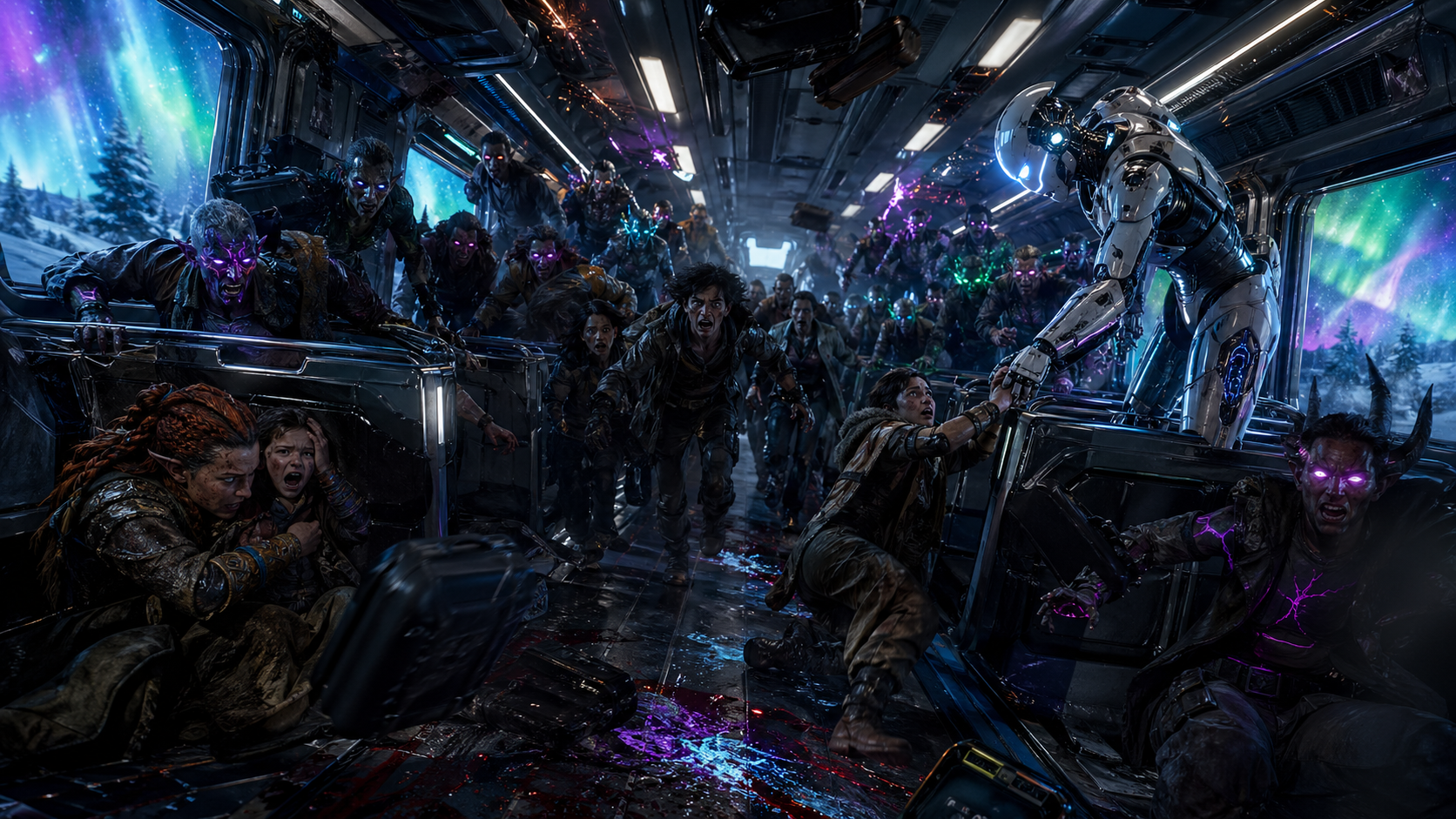
I just learned the first problem every ambitious DM eventually collides with:
Cinematic Scale vs Table Velocity
I wanted my encounter to feel overwhelmingly unfair. Seven players trapped on a moving train, staring down what looked like certain death. When I revealed the battle map at the end of Session 1, the reaction was exactly what I hoped for. Memes started appearing in Discord almost immediately. Players were joking about preparing backup characters before the fight had even begun.
That tension was the goal.
The mistake I made was softening it too early.
I gave the party a surprise round to start cutting into the enemy count before the combat properly began. In hindsight, I probably didn’t need to. I already had multiple contingency valves prepared if things became truly catastrophic. Then, during the fight, I narrated a missed attack cracking one of the train windows, which our Paladin immediately exploited by hurling a suitcase through it and using the pressure differential to wipe out several enemies at once.
It was cinematic. It was memorable. It was exactly the kind of emergent gameplay I want to reward.
But combined with the surprise round and a later civilian stampede that flattened another cluster of enemies, the encounter lost too much mass too quickly. The players never had enough time to fully absorb the feeling of being trapped inside the danger before the danger started collapsing around them.
That’s the balancing act I’m beginning to understand:
not how to make encounters deadly,
but how to make them linger.
The original design was 26 pressure units, not 26 true combatants. Their purpose was to create saturation, chaos, and the sensation of being overwhelmed. Mechanically, that part worked. Emotionally, though, the atmosphere shifted the moment the players subconsciously realized:
“These enemies exist to die.”
Once that realization sets in, tension changes shape. Survival horror becomes target practice with dramatic lighting.
The other major lesson was pacing.
The combat took a little over two hours, even with me moving quickly through enemy turns. Most enemies only consumed fifteen or twenty seconds individually, but scale changes the math. Twenty-four fast turns are still twenty-four turns. Eventually the rhythm became:
DM speaks → dice roll → DM speaks → dice roll → DM speaks → dice roll.
The players weren’t bored because the turns were slow. They were bored because the structure fragmented attention into too many procedural moments. They became spectators in my physics engine when what I really wanted was simultaneous catastrophe.
Especially in cyberpunk.
Cyberpunk combat should feel volatile, asymmetrical, and unstable. It should feel like the environment itself is trying to kill you. A moving train full of terrified civilians shouldn’t behave like static terrain. It should feel reactive and dangerous enough that the battlefield becomes part of the narrative.
Which is why the shattered train window worked so well.
The lesson isn’t “don’t reward environmental creativity.” If the environment never matters, the battle map is just decorative geometry. The real lesson is that every environmental interaction has a pressure value. The cracked window was good. The civilian stampede was good. The surprise round was probably fine. But layered together, they compressed the tension curve too aggressively.
I think the future solution is squad-based combat.
Instead of 26 independent enemies, the encounter could have been structured as four coordinated waves supported by two mini-bosses. Shared initiative. Shared movement. Shared attacks. Enemies functioning as suppressive pressure instead of individual bookkeeping entries.
Not only would that dramatically improve pacing, it would also improve texture.
And ultimately, that’s the real realization I’m taking away from this session:
Encounter badassery is not proportional to combat duration.
Players don’t remember enemy #17 hitting them for 3 damage. They remember impossible decisions, nervous laughter, collapsing momentum, clutch rolls, sacrifices, and the moment the train window shattered open into the frozen night.
That’s the feeling I’m chasing.
Leave a Reply