
A few months ago I made what, in hindsight, was an almost absurd decision:
I decided that if I was going to DM for the first time, I wasn’t going to run a prewritten module.
I was going to build an entire world from scratch.
Not just a setting. A functioning ecosystem.
I wanted a version of D&D that felt genuinely cyberpunk instead of simply reskinning fantasy races with neon lights duct-taped onto them. I wanted a world where magic had evolved alongside technology instead of existing separately from it. A world where megacorporations exploited arcane energy the same way modern companies exploit oil, electricity, and data. Where ancient runes were integrated into circuitry. Where the economy itself reflected the setting’s logic.
So I built one.
A fully homebrewed world.
Custom systems.
Modified mechanics.
A functioning economy.
A fluctuating stock market.
Black market infrastructure.
Custom corporations.
Cybernetic augmentation systems.
Arcane engineering.
Altered weapon mechanics.
New currencies.
New lore.
New tensions.
And because I apparently enjoy suffering, I decided to do all of this while simultaneously learning how to DM.
Looking back now, I think part of the reason I committed so hard to the worldbuilding was because I understood something intuitively before I understood it mechanically:
If the world felt real enough, the players would forgive the friction of learning it.
Session One proved that instinct was correct.
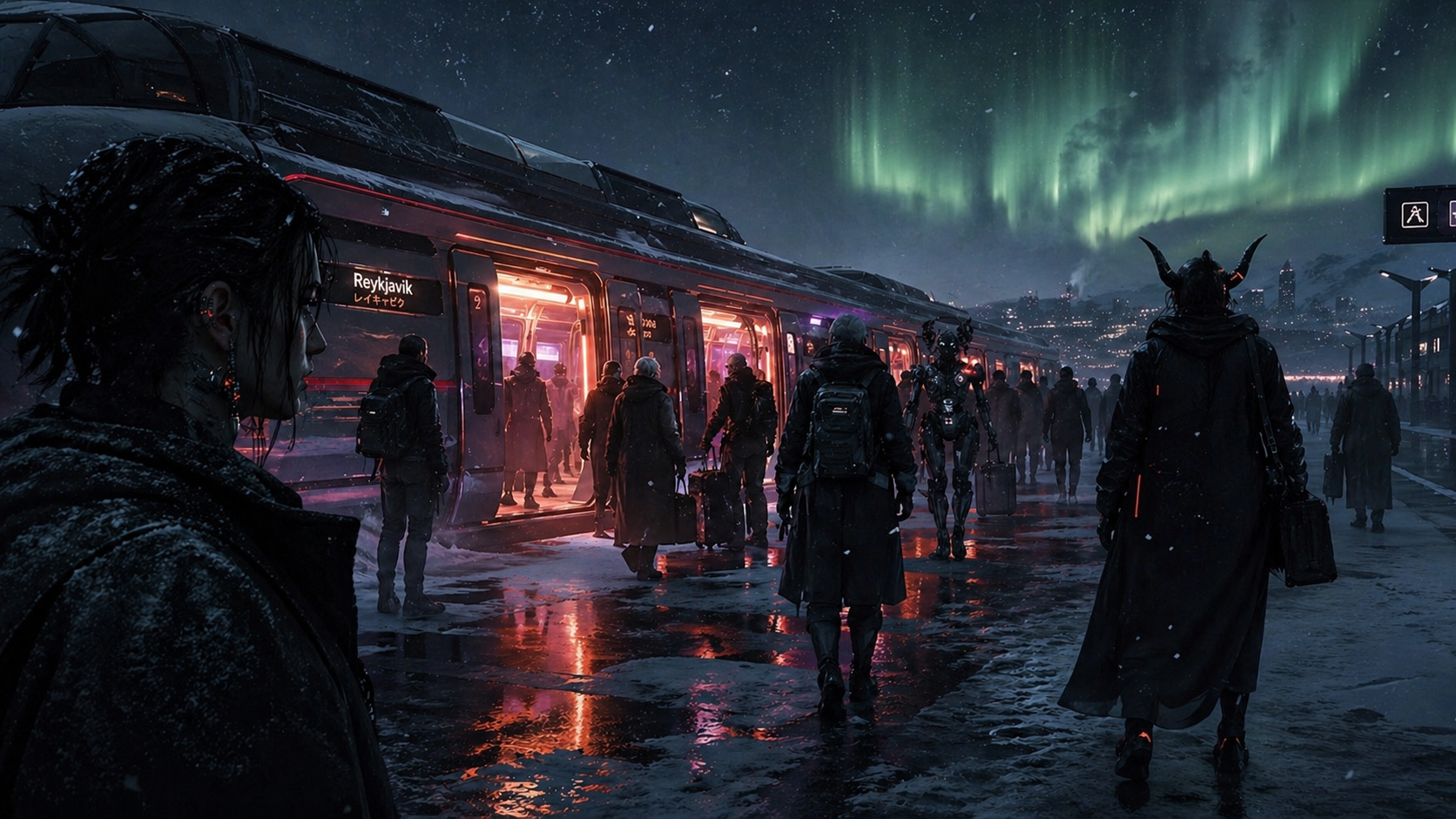
Before we even started the actual game, I showed the group the visuals I’d been building for the campaign. Character art. Environmental shots. Interface graphics. Cityscapes. Neon-drenched Icelandic skylines fused with arcane symbolism and industrial futurism. There’s a noticeable difference between people politely complimenting creative work and people emotionally buying into a world. The “holy shit” reactions weren’t really about image quality. They were about coherence. Suddenly the setting felt tangible.
That mattered because the intro narration depended entirely on atmosphere and trust.
I wanted the opening to feel cold, cinematic, and slightly sacred. Not exposition-heavy. Not lore dumping. Just immersion. Frozen tarmac beneath the aurora. Neon runes suspended in the winter air. Travelers existing inside a society where magic and technology had become inseparable from daily life. A world where the extraordinary had become mundane.
The biggest thing I learned was how powerful restraint can be.
I didn’t start the campaign with explosions or combat. I started with subtle wrongness:
- a passenger whose expression lingered unnaturally,
- aurora light bending in ways it shouldn’t,
- arcane energy that felt unstable beneath the surface.
Just enough distortion to activate instinct without immediately explaining itself.
I think that’s what made the setting feel believable. The world wasn’t screaming:
“LOOK HOW DARK AND COOL THIS IS.”
It behaved as though it already existed before the players arrived.
And then something happened that I honestly wasn’t expecting:
even while learning the system, the players stayed emotionally engaged.
This was not a veteran table running optimized turns with encyclopedic rules knowledge. We had:
- two completely new D&D players,
- multiple people learning new classes,
- an entirely new Foundry VTT setup,
- homebrew mechanics,
- altered systems,
- and me learning how to manage all of it in real time.
Combat in the first train car was objectively slow by experienced-table standards. But it never felt dead. Everyone was discovering the system together. Players were figuring out their abilities in real time, learning action economy, understanding reactions, testing movement, experimenting with spells, and trying to understand how their characters actually functioned inside the world.
And somehow, the tension survived all of that friction.
That was probably the biggest revelation of the night.
The players trusted the world long before they fully understood the mechanics.
The first combat encounter ended up becoming an accidental tutorial in stakes. One player got dropped to 0 HP during the fight before our Bard pulled them back up with Healing Word a few turns later. In retrospect, I think that moment was perfect for Session One. Dangerous enough to establish consequences. Recoverable enough to avoid creating fear paralysis.
The table learned something important in that moment:
this world bites back.
But it is not arbitrarily cruel.
That distinction matters.
What also worked surprisingly well was the progression of escalation. The first train car felt tense but manageable. The players were under pressure, but they still felt agency. Then they moved into the second car and encountered something much larger, much more chaotic, and much more psychologically overwhelming.
That’s where I ran headfirst into the next major lesson:
the collision between cinematic scale and table velocity.
But honestly, that realization belongs to Session Two.
What Session One taught me was something more foundational:
Immersion is not created by mechanics alone.
It’s created when players believe the world exists independently of them.
If they believe that, they’ll tolerate slower combat.
They’ll forgive imperfect pacing.
They’ll stumble through rules.
They’ll stay curious through confusion.
Because emotionally, they’re already inside the train.
Leave a Reply