
When I first decided to DM, I made a very dangerous mistake:
I treated the words “homebrew setting” like a challenge instead of a warning label.
Most people start with:
- a town,
- a few NPCs,
- maybe a modified subclass,
- and a dream.
I apparently decided to start with:
“What if I built a fully simulated cyberpunk civilization powered by arcane energy and then forced myself to learn how to run it in real time?”
So naturally, that became the project.
Not just lore.
Not just aesthetics.
Infrastructure.
I wanted the world to feel systemic.
Not “video game cyberpunk.”
Not neon wallpaper stretched over medieval fantasy.
A living ecosystem where:
- megacorporations monopolized magical resources
- economies fluctuated
- transit systems mattered
- districts had political identities
- geography shaped culture
- and technology evolved through magic instead of replacing it.
The deeper I got into building the world, the more I realized something:
Players can instantly tell the difference between a setting that was invented and one that was considered.
That realization completely changed how I approached campaign prep.
Instead of designing isolated set pieces, I started designing interfaces, transit systems, media feeds, corporate ecosystems, and public infrastructure. I even went on an ADD side quest spending a few hours designing a functioning stock market system in Excel that responds to what the players are doing in the world. I wanted players to feel like they had entered a world already in motion before their characters ever existed inside it.
That philosophy is what led to some of the visual systems I’m probably most proud of so far.

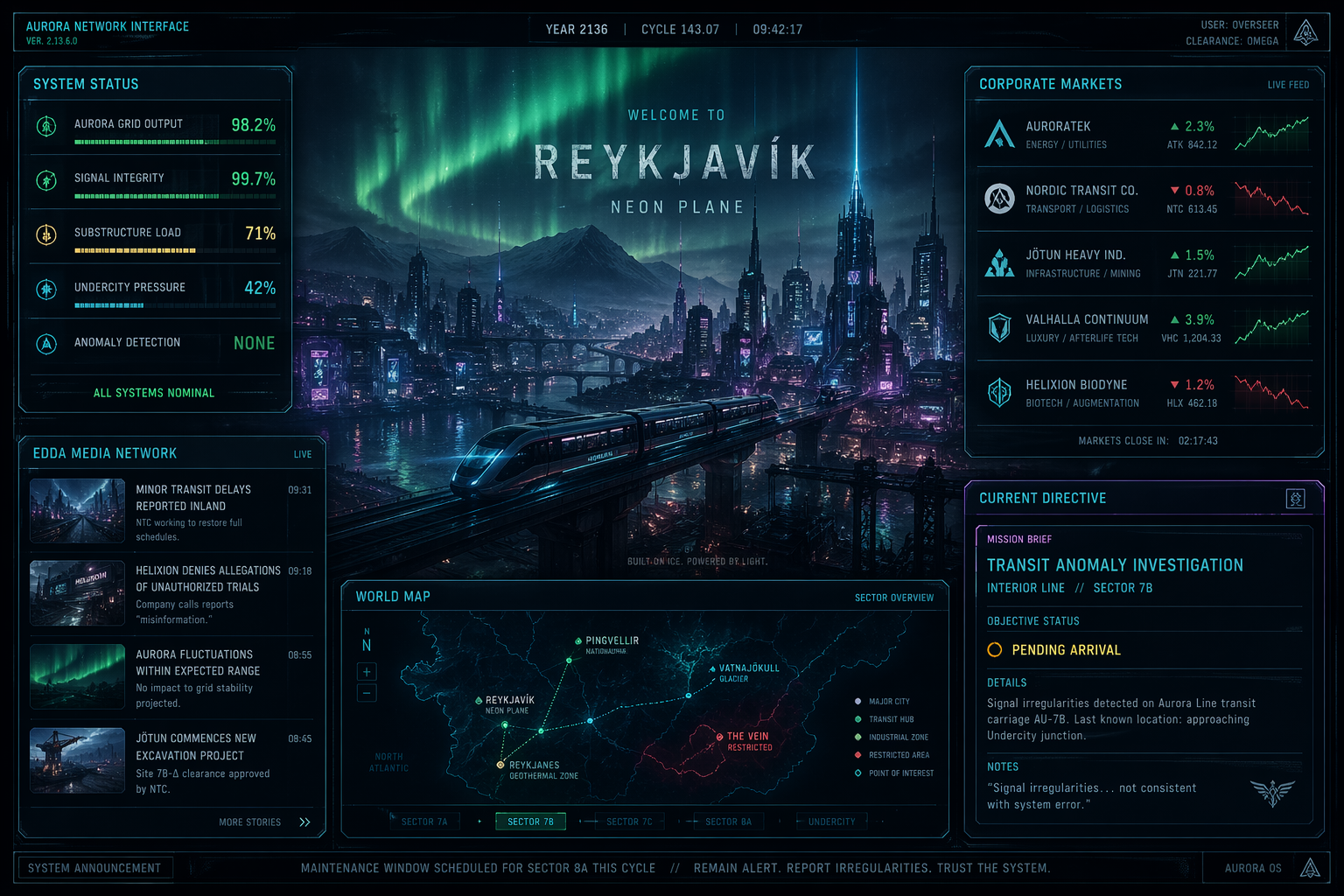
The first major breakthrough was building the actual world interface for Reykjavík itself.
This was the moment the setting started feeling real to me.
Not because the graphics looked polished, but because the interface implied systems beyond the players’ immediate perspective:
- market fluctuations
- transit anomalies
- corporate influence
- infrastructure strai,
- hidden instability beneath “ALL SYSTEMS NOMINAL.”
That last part became extremely important philosophically.
Cyberpunk worlds should always feel like they’re smiling while actively bleeding internally.
The next thing I became obsessed with was player presentation.
I didn’t want the party to feel like disconnected fantasy archetypes awkwardly standing next to each other. I wanted them to feel like registered entities inside a monitored network ecosystem.
So I built an active entity roster for the campaign.

This ended up doing something I didn’t fully expect:
it psychologically unified the party before the campaign even began.
Suddenly the players weren’t just “a D&D group.”
They were:
- tracked,
- categorized,
- monitored,
- and surviving inside a hostile system.
That subtle framing matters.
Then came the maps.


And honestly, the maps are where the project stopped feeling like campaign prep and started feeling like world archaeology.
I didn’t want regions to exist just for biome variety. I wanted geography to imply history, resource distribution, political fragmentation, and mythological contamination.
So Iceland slowly evolved into this fractured neon wasteland of sovereign territories, industrial scars, geothermal infrastructure, frozen expanses, and corrupted regions bleeding with arcane instability.
The city map of Reykjavík became even more obsessive.
Because districts tell stories before NPCs ever do.
You can immediately understand a city by:
- what it protects
- what it hides
- where wealth accumulates
- where infrastructure decays
- and where people disappear
I wanted every district name to sound like it had survived decades of corporate pressure, economic adaptation, and cultural mutation.
Even the transit system became part of the storytelling.

The Aurora Line wasn’t just transportation. It became symbolic:
a gleaming artery carrying people through a civilization quietly destabilizing beneath the surface.
Which is why the train imagery mattered so much to me.
And finally, the airport.

This image might actually represent the entire campaign philosophy better than anything else I’ve made.
Because that’s the world in one frame:
- fantasy races
- impossible technology
- cold industrial infrastructure
- commercialization
- surveillance
- mythology
- and wonder existing simultaneously
The more I build this campaign, the more I realize worldbuilding isn’t really about “creating content.”
It’s about creating continuity of belief.
Every screen, map, corporation, transit line, stock ticker, district, and visual element exists to answer a subconscious player question:
“Does this world continue beyond the edge of the camera frame?”
That’s the threshold I’m chasing.
The moment where players stop interacting with a campaign…
…and start inhabiting a civilization.
Leave a Reply